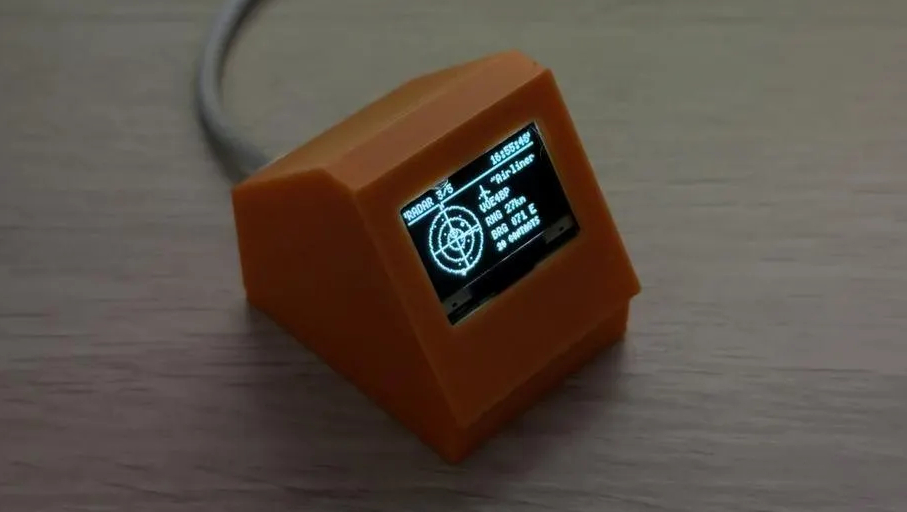
Your Own Air Traffic Display
Aircraft tracking has never been more accessible. Services such as FlightRadar24 and OpenSky make it possible to see thousands of flights moving across the globe in real time from a smartphone or web browser.
But sometimes a browser tab isn't enough.
GitHub user Danilo Cannas has created Plane Spotter, a small desktop gadget that continuously monitors the airspace around your home and presents the information through a military-inspired radar interface. Built around an ESP8266 and a 0.96-inch OLED display, the project delivers live flight tracking, weather data, and system information using about $10 worth of hardware.
A Radar Screen for Your Desk
The hardware requirements are quite simple. The build uses an ESP8266 development board such as a Wemos D1 Mini or NodeMCU paired with a seven-pin SPI OLED display. Everything fits inside a small two-piece 3D-printed enclosure that can sit on a desk or be mounted to a wall.
Once connected to Wi-Fi, the device retrieves aircraft data from the OpenSky Network, weather information from Open-Meteo, route details from hexdb.io, and time synchronization through NTP services.
The firmware then transforms that data into a rotating collection of tactical-style display screens.
Five Screens of Aviation Data
Plane Spotter cycles through five different views every seven seconds.
The TARGET screen focuses on the nearest aircraft, displaying information such as callsign, altitude, heading, distance, bearing, and speed. The INTEL screen expands on that data by showing airline information, route details, and estimated arrival times when available.
The most visually interesting screen is RADAR. Here, aircraft appear as moving blips on a plan position indicator display with range rings and a rotating sweep line. Aircraft positions are dead-reckoned between updates so contacts continue moving smoothly even when fresh data has not yet arrived. The nearest aircraft is highlighted while a directional marker indicates the orientation of the wall or desk where the unit is mounted.
Additional screens provide local weather conditions, forecasts, Wi-Fi status, uptime information, memory statistics, and a large NTP-synchronized clock complete with milliseconds.
Built Around Open Data
An interesting aspect of the project is how much functionality comes from publicly available data sources.
The OpenSky Network provides ADS-B aircraft tracking data, while Open-Meteo supplies weather information without requiring an API key. Route and airline details come from hexdb.io, allowing the device to display information beyond raw aircraft positions.
The project also accounts for some of the realities of community-sourced aviation data. When aircraft type information is unavailable through OpenSky, the firmware estimates categories using altitude and speed data, clearly marking those classifications as approximations.
A Fun Use for a Tiny Display
There is no shortage of ESP8266 projects that display weather forecasts, clocks, or sensor readings. Plane Spotter manages to combine several of those ideas into something that feels a little different.
Instead of building another dashboard for monitoring your own devices, it turns a small OLED screen into a live window overlooking the sky above your home. For aviation enthusiasts, that's probably enough reason to build one.